The U.S. plasma collection landscape has undergone significant changes over the past two decades. As Kristopher Jonas recently noted, independent collectors now account for just 15% of U.S. plasma volume—down from 40%+ in the early 2000s. That figure may represent a high-water mark, but does it also signal the end of independent growth? Our analysis suggests: not necessarily.
Using the most current FDA/PPTA/Market Research data from 2021 to 2023, the U.S. collected approximately 43 million liters of plasma from 1,234 licensed centers—an average of around 35,000 liters per center per year. With global demand expected to increase, the U.S. is projected to contribute an estimated 55 million liters by 2030, maintaining its historical share of global supply.
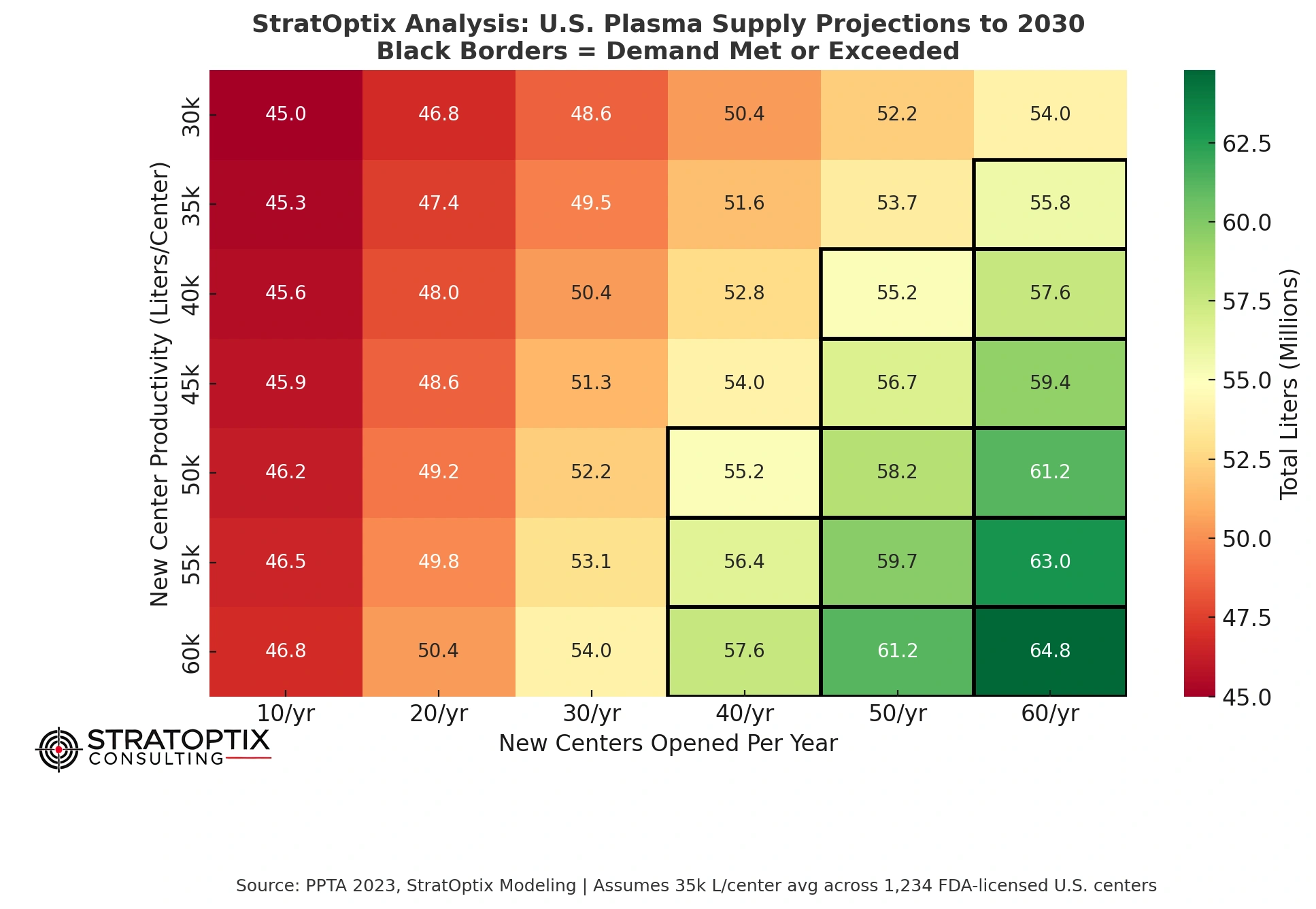
We explored a range of scenarios for bridging that gap, focusing on the interplay between new center growth and improved operational efficiency. Our analysis found that achieving this 2030 target is possible if either:
- Roughly 40 new centers open each year, operating near 45,000 liters annually, or
- Existing centers optimize operations, improving throughput from 35,000 to 45,000 liters/year
But these aren’t the only paths. Even moderate growth—20–30 new centers/year—combined with incremental performance improvements across the footprint, could still meet demand. This underscores a critical point: optimization has the highest leverage. Unlike capital-heavy expansion, optimizing donor flow, staffing models, and scheduling can yield faster and more sustainable returns.
This also highlights a significant opportunity for independent operators. While vertically integrated firms may dominate in terms of scale, independents can thrive through precision, speed, and a regional focus. A small network of centers, if run efficiently, can materially contribute to the national supply needs. In fact, based on our modeling, independent centers operating near the 45K mark are just as impactful as a larger network with average performance.
As such, the 15% share may not be a ceiling—it could be a strategic foothold. The future for independents lies not in scale alone, but in proving the value of every liter collected.
We’re not at the ceiling—we’re at a crossroads. Efficiency will define who thrives.
References:
- Plasma Protein Therapeutics Association (2021). Global Plasma Supply Trends
- U.S. FDA (2024). Blood Establishment Registry Database
- Grand View Research (2023). Plasma Derived Therapy Market Report
- Fortune Business Insights (2023). Plasma Fractionation Market Report
- Haemonetics (2023). Investor Reports and Clinical Insights
Modeling Assumptions:
- 2023 baseline: 1,234 U.S. licensed centers; ~43.2M liters total collected
- Average liters per center in 2023: ~35K
- Demand CAGR through 2030: estimated at 6.0% to 7.2%
- 2030 demand modeled at 55 million liters
- Optimization target: 45K liters/center (based on top-performing operators)
- New center capital investment noted but not calculated in this model
StratOptix helps operators unlock performance potential. Efficient plasma collection isn’t about how many centers you own—it’s how well they run.
Follow StratOptix on LinkedIn to stay informed.