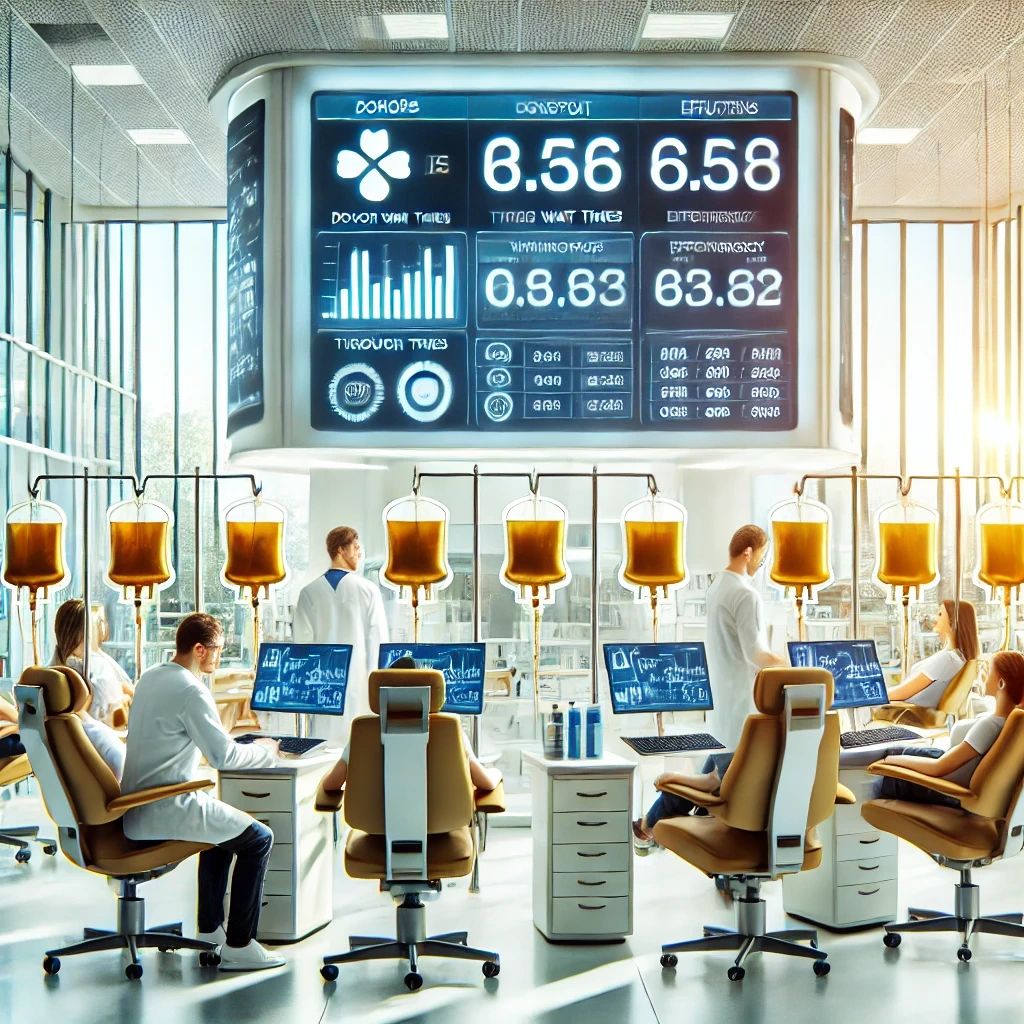
Plasma collection centers operate in a high-demand, efficiency-driven industry where minor improvements in operational benchmarks can yield substantial financial and productivity gains. Leaders must analyze key performance indicators (KPIs) such as donor frequency, donor processing times, and labor efficiency to assess whether a plasma center is achieving operational excellence.
Operational Excellence Checklist
✅ Donor Frequency: Are you achieving a monthly donor frequency of 5.0 or better?
✅ Donor Retention: Do you retain 80%+ of your qualified unique donors monthly?
✅ Return Donor Processing Time: Is your “in the door, out the door” time under 70 minutes for return donors?
✅ New Donor Processing Time: Are new donors completing the process in under 120 minutes?
✅ New Donor Acquisition: Are you accepting 50-100 new donors per week?
✅ Labor Efficiency: Is your Donations per Employee Hour (DEH) or Hours per Donation (HPD) meeting optimal benchmarks?
✅ Screening Throughput: Are screening stations processing 8-10 donors per hour?
✅ Employee Turnover: Is employee turnover stable or decreasing?
✅ Facility Utilization: Are you operating at 80%+ of your theoretical capacity?
✅ Theoretical Yield: Are you achieving 99% of theoretical yield?
✅ Online Reputation: Are your online reviews 4 stars or better?
Why These Metrics Matter
Most plasma companies recognize these benchmarks as key to success. While investors may require additional context, the challenge often lies in identifying practical and sustainable steps to achieve them effectively. Implementing the right strategies can make the difference between simply meeting targets and optimizing long-term operational efficiency.
Meeting these benchmarks consistently can result in six-figure returns annually for a single center and millions for multi-center organizations. The best part? These improvements cost little to nothing to implement and rely more on operational discipline, process optimization, and strategic execution than significant financial investment.
If your center is not meeting these attainable benchmarks, you are:
❌ Losing Revenue – Inefficient donor throughput and high donor attrition mean fewer collections, directly impacting profitability.
❌ Increasing Costs – Low labor efficiency and poor donor retention drive up operational expenses due to excessive hiring, training, and new donor incentives.
❌ Increasing Employee and Donor Turnover – Poor efficiency and long wait times create frustration, leading to higher attrition rates among staff and donors, compounding recruitment and retention challenges.
Centers that consistently meet or exceed these benchmarks operate optimally, reducing costs and improving donor retention. Leadership must continuously monitor these KPIs, implement technology where possible, and refine processes based on real-time data. If your center falls short, it may be time for a strategic review of operational workflows and efficiency improvement initiatives.